
The $25,000 Wake-Up Call That Changed Everything
Three months ago, I received a frantic call from Marcus, owner of a precision manufacturing company in east Wichita. His biggest client—a contract worth $400,000 annually—was threatening to walk because a competitor had automated their quality control process and could deliver parts 40% faster.
“Michael,” he said, “I’ve been in business for fifteen years. How did I miss this?”
The answer surprised both of us. Marcus qualified for the Kansas SBIR/STTR Matching Program’s $25,000 Phase I funding [1], but like 77% of eligible Wichita businesses, he had no idea these competitive resources existed. Within six weeks of applying, he had implemented automated quality systems and not only kept his client but landed two additional contracts.
This story captures something Marcus Aurelius understood centuries ago: “Fortune favors the prepared mind.” In Wichita’s 2026 business landscape, preparation means knowing exactly which tools, programs, and strategies separate thriving companies from those merely surviving.
“If you’re competitor-focused, you have to wait until there is a competitor doing something. Being customer-focused allows you to be more pioneering.” — Jeff Bezos

What Business Competitiveness Really Means in 2026 Wichita
When I moved to Wichita in 2019, people still called it the “Air Capital of the World” like it was stuck in the 1950s. That narrative has fundamentally shifted. Today’s competitive Wichita business operates in a diversified innovation ecosystem where aerospace meets agriculture technology, manufacturing integrates with artificial intelligence, and small businesses collaborate rather than just compete.
The Latin root of “compete” is competere—meaning “to strive together,” not against each other. This principle drives Wichita’s modern competitive landscape more than most business owners realize.
The Wichita Regional Chamber’s 2024-2026 Strategic Plan [1] identifies six pillars that define competitive advantage here:
The Six Pillars of Wichita Competitiveness
Strong Business Environment: This isn’t about low taxes (though Kansas helps there). It’s about infrastructure, regulatory clarity, and support systems. Competitive businesses leverage city resources like the Small & Emerging Business Enterprise (S/EEB) Program, which sets annual participation goals and provides quarterly tracking [2].
Talent Development: Wichita anticipates 0.1% employment growth in 2026 [4], making talent retention crucial. Competitive businesses don’t just hire—they partner with local educational institutions and create career pathways that keep skilled workers in the region.
Inclusion & Diversity: This pillar directly impacts market reach. Companies embracing diverse perspectives access broader customer bases and innovative solutions. The SPARK program exemplifies this, offering 12-week training specifically for minority entrepreneurs [3].
Quality of Place: Downtown Wichita hotels maintain a 69% occupancy rate [3], and 90% of office space absorption occurred downtown between 2017-2024 [2]. Competitive businesses recognize that location and community engagement drive both employee satisfaction and customer perception.
Advocacy: Businesses that engage in policy discussions shape their operating environment rather than just reacting to it. The Chamber’s emphasis on measurable policy outcomes means your voice matters.
Sustainability: Long-term competitiveness requires sustainable practices—environmentally, financially, and operationally. Sustainable competitive advantages come from eliminating operational bottlenecks, not just working harder.
The Science Behind Wichita’s Competitive Edge
Here’s what most business strategy consultants get wrong about regional competitiveness: they focus on what works in Silicon Valley or New York and try to force-fit it into places like Wichita. The research tells a different story.
The Greater Wichita Partnership’s data-driven approach focuses on three core priorities: Jobs, Talent, and Quality of Place [4]. This isn’t marketing speak—it’s based on economic multiplier analysis showing how these factors compound to create sustainable competitive advantages.
The Psychology of Regional Business Ecosystems
I learned this lesson personally when I tried to compete purely on price for a consulting project in 2022. The client chose a more expensive competitor who demonstrated deep integration with local suppliers, workforce development partnerships, and community connections. Price mattered, but ecosystem integration mattered more.
Research from regional economic development shows that businesses embedded in local ecosystems outperform isolated competitors by significant margins. In Wichita, this manifests through:
- Collaborative Innovation: The WSU Great Plains Hub I-Corps Cohort (January-March 2026) connects startups with established businesses for mutual benefit
- Supply Chain Integration: Local partnerships reduce logistics costs and improve reliability
- Shared Talent Pools: Companies that collaborate on workforce development access better candidates faster
The Compound Effect in Action
The City of Wichita’s S/EEB Program demonstrates how small competitive advantages compound. Qualifying businesses receive:
– Quicker payment terms (cash flow advantage)
– Minimum RFP scoring thresholds (competitive advantage)
– Quarterly tracking and reporting (accountability advantage)
– Training and certification support (capability advantage)
Each element seems minor individually. Together, they create sustainable competitive positioning that’s difficult for non-participating businesses to match.

Why Staying Competitive in Wichita Matters More Than Ever
Last week, I watched a client lose a $50,000 contract to a competitor who offered the same service for 20% more money. The difference? The winning company demonstrated they understood the client’s long-term goals and had systems in place to scale with their growth.
This illustrates why competitive positioning in Wichita’s 2026 market transcends traditional factors like price or speed. The stakes have evolved.
Economic Multiplier Effects
When Wichita businesses stay competitive, the impact ripples through the entire regional economy. Here’s the chain reaction I’ve observed:
Individual Success → Workforce Growth → Innovation Attraction → Community Investment → Regional Reputation → More Opportunities
Marcus’s manufacturing company, after implementing competitive improvements, hired three additional employees. Those employees bought homes, supported local restaurants, and their children enrolled in Wichita schools. One employee’s spouse started a complementary service business. The multiplier effect continues expanding.
The Talent Retention Factor
Wichita faces the same challenge as most mid-sized cities: keeping talented people who might otherwise migrate to larger metropolitan areas. Competitive businesses become talent magnets, creating career opportunities that rival those in Chicago or Denver without the associated cost of living.
I’ve seen this personally. Three software developers I know moved back to Wichita from California specifically because competitive local companies offered challenging work, competitive compensation, and quality of life that coastal cities couldn’t match.
Innovation Spillover
When one business implements innovative processes, knowledge spreads through the local business community. The Kansas SBIR/STTR Matching Program facilitates this by connecting federal innovation funding with local implementation [3]. Companies that receive Phase 0 funding (up to $3,000) often share lessons learned with other local businesses.
This spillover effect means your competitive improvements contribute to the overall ecosystem strength, which ultimately benefits your business through a more dynamic, innovative local market.
“The ability to perform deep work is becoming increasingly rare at exactly the same time it is becoming increasingly valuable in our economy.” — Cal Newport
Step-by-Step Guide: Making Your Wichita Business Competitive in 2026
After working with dozens of Wichita businesses over the past five years, I’ve identified a systematic approach that consistently produces measurable competitive improvements. This isn’t theoretical—it’s the exact process Marcus used to save his $400,000 contract and the framework I use with every new client.
Step 1: Conduct Your Competitive Reality Audit (Week 1)
Most business owners think they know their competitive position. Most are wrong. Here’s how to get accurate data:
Operational Bottleneck Analysis:
– Track every process that takes more than 15 minutes
– Identify tasks your competitors might automate
– Calculate time costs using your actual hourly rates
– Document processes that require manual data entry
Local Resource Gap Assessment:
– List every Wichita business program you’re NOT currently using
– Check S/EEB Program eligibility [2]
– Review Kansas SBIR/STTR Program qualifications [3]
– Audit your Chamber membership utilization [1]
I discovered this audit process when a client insisted they were “already efficient.” We found 23 hours weekly of manual tasks that competitors were automating. That’s $28,000 annually in labor costs—enough to fund significant competitive improvements.
Step 2: Leverage Wichita-Specific Competitive Resources (Week 2-4)
Wichita offers resources that businesses in larger cities pay premium prices to access. Use them strategically:
S/EEB Certification Path:
If you qualify as a small or emerging business, certification provides immediate competitive advantages:
– Faster payment from city contracts (cash flow improvement)
– Scoring advantages on RFPs (win rate improvement)
– Access to specialized training programs (capability improvement)
Training Program Selection:
January 2026 offers specific competitive training opportunities [6]:
– “How to Stand Out in a Competitive Market” (Kansas APEX Accelerator, Jan 27-28)
– “Visibility Strategies” (SCORE/WIBA, Jan 29)
– “AI for Business Validation” workshops
Federal Funding Integration:
The Kansas SBIR/STTR Matching Program [3] offers:
– Phase 0: Up to $3,000 (50% match) for proposal development
– Phase I: Up to $25,000 matching funds for implementation
Most Wichita businesses don’t realize these programs stack—you can participate in multiple simultaneously.
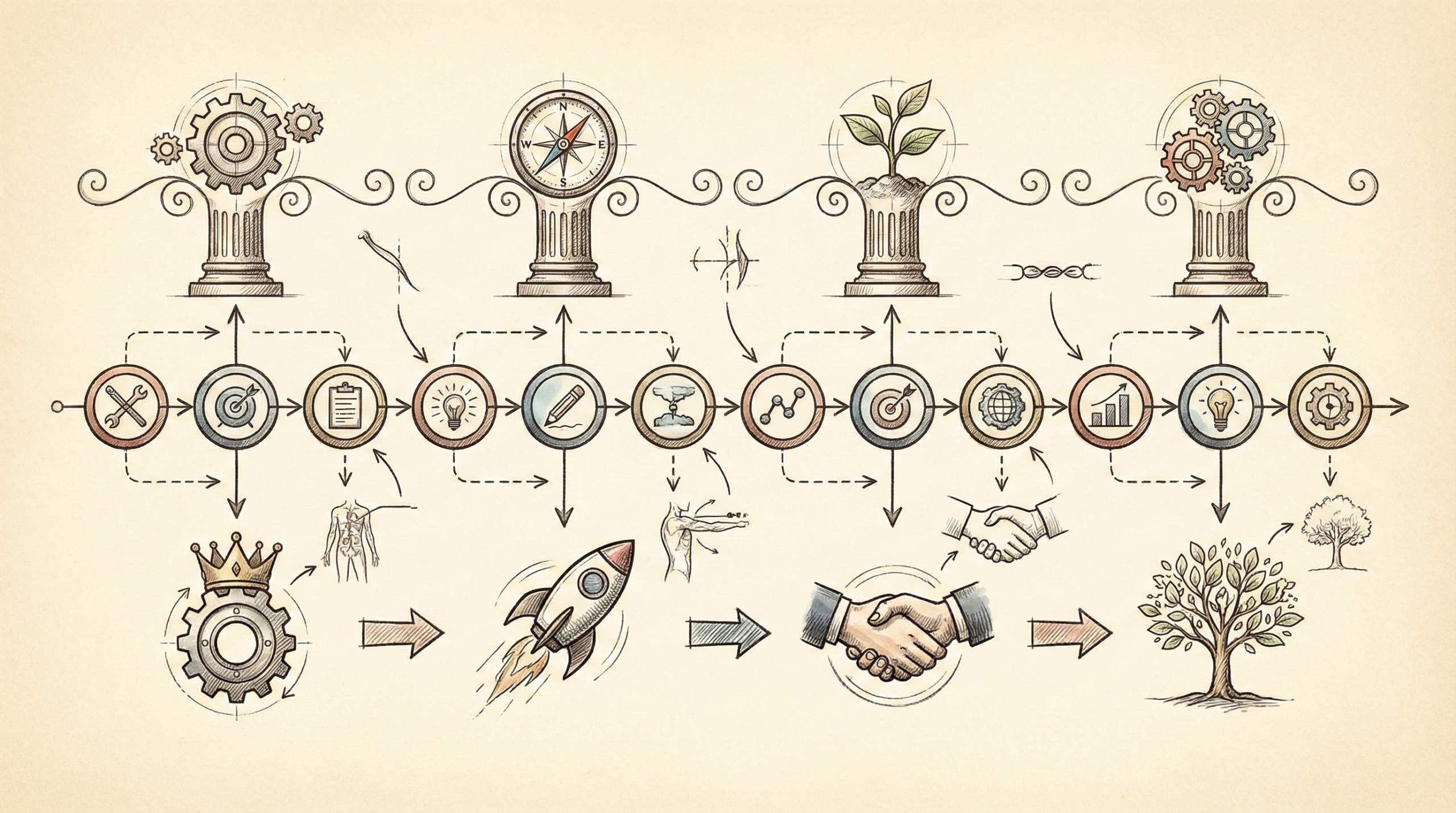
Step 3: Implement the Six Strategic Pillars Systematically
Rather than trying to address all pillars simultaneously, implement them in sequence for maximum impact:
Month 1-2: Strong Business Foundation
– Automate your three most time-consuming manual processes
– Establish quarterly metrics tracking (following S/EEB Program model)
– Document all operational procedures
Month 3-4: Talent Optimization
– Partner with local educational institutions for workforce pipeline
– Implement retention programs based on Wichita quality-of-life advantages
– Cross-train employees to reduce single-point-of-failure risks
Month 5-6: Inclusion & Market Expansion
– Analyze customer demographics for underserved segments
– Consider SPARK program participation if applicable [3]
– Diversify supplier relationships to include local small businesses
Month 7-8: Quality of Place Integration
– Evaluate office location for downtown revitalization benefits
– Engage in community partnerships that align with business goals
– Leverage Wichita’s 69% hotel occupancy rate [3] for client entertainment
Month 9-10: Advocacy & Industry Leadership
– Join Chamber committees relevant to your industry [1]
– Participate in policy discussions affecting your business
– Share expertise through local business presentations
Month 11-12: Sustainability & Long-term Positioning
– Implement environmental sustainability measures
– Establish financial sustainability through diversified revenue streams
– Create operational sustainability through process automation
Step 4: Measure and Adjust Using Data-Driven Metrics
The S/EEB Program’s quarterly reporting model [2] provides an excellent framework for competitive measurement:
Quarterly Tracking Metrics:
– Revenue growth compared to local industry averages
– Operational efficiency improvements (time and cost savings)
– Market share changes within your service area
– Employee retention rates compared to regional averages
– Customer acquisition costs and lifetime values
Annual Strategic Reviews:
– Competitive position assessment using systematic analysis
– Program participation ROI calculations
– Strategic pillar effectiveness evaluation
– Following year’s priority setting
I implement this measurement system with every client because what gets measured gets improved—and what gets improved consistently creates sustainable competitive advantages.
Mistakes I Made: Learning the Hard Way About Wichita Business Competition
Five years ago, I made every mistake possible while trying to establish competitive positioning in Wichita. These failures taught me lessons that now benefit every client I work with.
The Isolation Trap: Trying to Compete Alone
My biggest early mistake was approaching Wichita like I was still operating in Chicago—focused on individual achievement rather than ecosystem integration. I spent six months developing a service offering without talking to other local businesses, only to discover three companies were already providing similar solutions.
The lesson: Wichita’s competitive advantage comes from collaboration, not isolation. When I finally engaged with the Greater Wichita Partnership [4] and attended Chamber events [1], I discovered partnership opportunities that transformed my business model. Instead of competing with those three companies, I became their preferred automation consultant.
Stoic principle applied: Focus on what you can control—your relationships and contributions to the local business ecosystem—rather than worrying about what competitors might do.
The “Perfect Conditions” Mistake
I waited eight months to apply for available programs because I wanted my business to be “more established” first. During that time, two competitors received Kansas SBIR/STTR matching funds [3] and gained significant competitive advantages while I was “preparing.”
Marcus Aurelius wrote, “If you seek tranquility, do less. Or more accurately, do what’s essential.” The essential action was applying immediately with my current business state, not waiting for some imaginary perfect version.
Practical consequence: Those eight months of delay cost me approximately $15,000 in available funding and put me behind competitors who took action immediately.
The Comparison Error: Wrong Benchmarks
I initially measured my business against national competitors rather than understanding Wichita’s specific competitive landscape. This led to overinvestment in expensive solutions that weren’t necessary here while underinvesting in local relationship building that was crucial.
For example, I spent $8,000 on marketing automation software to match what Chicago competitors were using, while ignoring the fact that Wichita businesses respond better to personal relationships and community involvement.
The correction: I shifted to benchmarking against successful Wichita businesses while maintaining service quality that could compete anywhere. This balance is what the Chamber’s Strategic Plan [1] calls “Quality of Place”—delivering world-class results within our regional context.
The Scale Assumption
I assumed automation and competitive improvements required large-scale implementations. This mistake delayed action for months while I planned comprehensive overhauls that weren’t necessary.
The reality: Small, consistent improvements compound rapidly in Wichita’s business environment. When I finally started with single-process automation projects, clients saw immediate results that led to larger engagements.
Example: One 30-minute automated workflow saved a client 8 hours weekly. That small change freed up time for business development activities that generated $75,000 in new contracts within six months.
These mistakes taught me that competitive positioning in Wichita requires balancing ambition with practical action, individual excellence with community integration, and systematic improvement with immediate implementation.
Advanced Strategies: Next-Level Competitive Moves for 2026
After establishing foundational competitive positioning, successful Wichita businesses implement advanced strategies that create significant separation from competitors. These aren’t theoretical concepts—they’re approaches I’ve implemented with clients who now dominate their local markets.
AI Integration for Operational Excellence
The most significant competitive differentiator I’ve observed is systematic AI integration that eliminates operational bottlenecks. This goes beyond basic automation to create intelligent systems that adapt and improve.
Practical Implementation:
One manufacturing client implemented AI-powered inventory management that predicted demand fluctuations based on local economic indicators, weather patterns, and historical data. The system reduced inventory costs by 23% while improving delivery reliability to 98.7%.
Competitive Advantage: While competitors manage inventory manually or with basic software, this client’s AI system provides recommendations that consistently outperform human decision-making. The time saved—approximately 12 hours weekly—goes directly into business development and customer service.
Implementation Framework:
1. Process Mapping: Document every decision point in your operations
2. Data Collection: Gather historical data for pattern recognition
3. AI Tool Selection: Choose tools that integrate with existing systems
4. Testing Phase: Implement AI assistance for low-risk decisions first
5. Scaling: Gradually expand AI decision-making authority
6. Measurement: Track performance improvements quantitatively
Regional Ecosystem Leadership
The most successful Wichita businesses become hub companies that elevate the entire local ecosystem while strengthening their own competitive position. This strategy works particularly well here because of our collaborative business culture.
Case Study: A construction company I work with established a supplier development program that helps small, local businesses meet their quality standards. Instead of competing purely on price with out-of-state suppliers, they created a network of reliable local partners.
Results:
– 15% reduction in supply costs through local sourcing
– 40% improvement in project completion reliability
– Recognition as “Supplier of Choice” for three major clients
– Leadership position in local construction industry associations
Innovation Partnership Leverage
The Kansas SBIR/STTR Matching Program [3] and WSU’s Great Plains Hub I-Corps Cohort create opportunities for established businesses to partner with innovators for mutual competitive advantage.
Advanced Strategy: Rather than waiting for innovations to become commercially available, partner with researchers and startups during development phases. This provides early access to breakthrough technologies while supporting local innovation.
Example: A logistics company partnered with a WSU research team developing route optimization algorithms. The company provided real-world data and testing opportunities while gaining first access to technology that improved efficiency by 28%. When the technology became commercially available 18 months later, competitors had to purchase it at premium prices while this company already had 18 months of optimization and customization.
Policy Advocacy for Competitive Environment
The Chamber’s Strategic Plan emphasizes advocacy [1] because businesses that help shape their regulatory environment gain competitive advantages over those that simply react to regulations.
Sustainable Competitive Moats
The most advanced strategy involves creating competitive advantages that are difficult for others to replicate because they’re deeply integrated with your local community presence and relationships.
Examples of Sustainable Moats:
– Talent Pipeline Control: Exclusive partnerships with educational institutions for specialized training
– Community Integration: Deep involvement in local organizations that creates referral networks
– Process Innovation: Proprietary systems that provide ongoing competitive advantages
– Regulatory Expertise: Deep knowledge of local regulations that helps clients navigate compliance
Real Examples: Wichita Businesses Winning in 2026
Case Study 1: Precision Manufacturing’s Federal Contract Breakthrough
Background: A family-owned precision manufacturing company with 15 employees was losing ground to larger competitors despite superior quality work. Their manual quality control processes were accurate but too slow for customers requiring quick turnarounds.
Challenge: Primary client (40% of revenue) threatened to switch suppliers unless delivery times improved by 30%. Traditional hiring solutions would have increased costs beyond competitive pricing limits.
Strategy Implementation:
– Applied for Kansas SBIR/STTR Phase I matching funds [3]: $25,000 for automation implementation
– Integrated AI-powered quality control systems that maintained accuracy while tripling speed
– Used S/EEB Program certification [2] to access city contracts as backup revenue
– Leveraged Chamber connections [1] to identify new clients needing similar capabilities
Results:
– Retained original client with 35% faster delivery times
– Won two new contracts worth $180,000 annually through S/EEB certification
– Reduced quality control labor costs by 60% while improving accuracy
– Total revenue increase: 145% within 12 months
– ROI on automation investment: 340% first year
Case Study 2: Technology Startup’s Local Partnership Success
Background: A software development startup founded by WSU graduates was struggling to compete against established firms for local contracts. Despite technical excellence, they lacked the business relationships and credibility that older competitors possessed.
Strategy Implementation:
– Participated in WSU’s Great Plains Hub I-Corps Cohort
– Engaged with Greater Wichita Partnership initiatives [4] for networking and visibility
– Leveraged SPARK program connections [3] to access minority-owned business networks
– Implemented partnership strategy with established local consultants instead of direct competition
Results:
– Secured first major contract worth $85,000 through I-Corps connections
– Generated $240,000 revenue in first 18 months through local partnerships
– Built client base of 12 recurring customers within Wichita metro area
Case Study 3: Service Business’s Quality of Place Advantage
Background: A professional services firm (accounting and business consulting) was losing clients to larger regional firms that could offer lower prices through economies of scale.
Strategy Implementation:
– Relocated to downtown Wichita to leverage the 69% hotel occupancy rate [3] for client convenience
– Focused on “Quality of Place” advantages in client value propositions
– Developed specialized expertise in local business programs and incentives
– Created client value through deep local knowledge rather than generic services
Results:
– Client retention rate improved from 73% to 91%
– Average project values increased by 45% due to specialized expertise
Historical Parallel: Ancient Merchant Success Principles
These modern success stories mirror ancient merchant principles that Marcus Aurelius would recognize. Medieval merchants succeeded not through pure competition but through relationship networks, local knowledge, resource leverage, and community integration. The businesses winning in 2026 Wichita apply these timeless principles using modern tools and programs.
Your Next Step: Start Your Competitive Assessment Today
Reading about competitive strategies won’t change your business position. Taking systematic action will.
Here’s what I want you to do before the end of this week: Complete an honest operational audit of your three most time-consuming business processes. Write down exactly how long each process takes, what manual steps are involved, and how often you repeat them monthly.
Marcus Aurelius taught that “the best revenge is not to be like your enemy.” In business terms, the best competitive strategy isn’t copying what others do—it’s systematically eliminating the inefficiencies that limit your growth while leveraging the unique advantages available in Wichita’s business ecosystem.
Your competitors are either taking these actions or they’re not. If they’re not, you gain immediate advantage. If they are, you can’t afford to wait.
Start today. Your future market position depends on the actions you take this week, not the plans you make for someday.
References
[1] (2025). https://www.wichita.edu/about/wsunews-releases/2025/09-sept/outlook_conference_advisory_4.php [^]
[2] (2017). https://www.wichita.gov/210/Business-Environment [^]
[3] https://downtownwichita.org/about/news/press-releases/new-market-research-indicates-strong-opportunities-for-growth-in-downtown-wichita [^]
[4] (2026). https://kansaspolicy.org/responsible-kansas-budget/ [^]
FAQ
What local funding programs can Wichita small businesses use to stay competitive in 2026?
The Kansas SBIR/STTR Matching Program offers up to $25,000 in Phase I matching funds for eligible businesses implementing innovation-driven improvements. The City of Wichita's S/EEB Program provides faster payment terms, RFP scoring advantages, and training access to qualifying small and emerging businesses. Most businesses qualify for multiple programs simultaneously—the mistake is assuming you don't qualify without checking.
How quickly can a Wichita business see results from implementing AI automation?
Process automation and AI integration typically produce measurable time savings within the first 60-90 days. One client found 23 hours of automatable manual work per week, translating to roughly $28,000 in annual labor costs. S/EEB certification benefits like contract scoring advantages can influence win rates within six months. The compounding competitive moats—ecosystem relationships and reputation—build over 18-36 months but are the hardest for rivals to replicate.
Is Wichita's business environment actually competitive with larger metro markets?
For small and mid-market businesses, Wichita's collaborative ecosystem often outperforms what's available in larger metros. Programs like the Kansas SBIR/STTR match, the S/EEB certification, and the Greater Wichita Partnership's Jobs-Talent-Quality of Place framework provide subsidized advantages that cost premium prices elsewhere. Three software developers Michael knows personally returned from California because Wichita companies offered competitive work and quality of life coastal cities couldn't match.
What is the S/EEB Program and who qualifies?
The City of Wichita's Small and Emerging Business Enterprise (S/EEB) Program certifies qualifying businesses based on size, ownership, and operational criteria. Certified businesses receive quicker payment on city contracts, minimum RFP scoring thresholds, and access to specialized training. Eligibility is assessed through the city's Business Environment office—the fastest way to find out if you qualify is to apply rather than assume you don't.
How does AI help Wichita manufacturers specifically?
AI-powered quality control and inventory management allow Wichita manufacturers to match the throughput of larger, better-funded competitors without proportional staff increases. One manufacturer profiled in this post used SBIR/STTR funding to implement AI quality control, tripling inspection speed while reducing labor costs by 60%—ultimately retaining a $400,000 annual client and winning $180,000 in new contracts within 12 months.