
You’re Not Imagining It: The $438 Billion Problem Hiding in Plain Sight
Last week, I watched a client’s VP of Engineering stare at his project dashboard with the kind of defeated expression usually reserved for tax audits. Seventeen active projects. All of them behind schedule. All of them with the same mysterious ailment: nothing was technically broken, but nothing was moving fast enough.
“My team works harder than anyone I know,” he told me. “But we’re always behind. Always.”
He’s not alone. Teams across the globe are hemorrhaging $438 billion annually in lost productivity [6], and most leaders think it’s about effort, talent, or resources. But after studying over 1,400 organizations, researchers discovered something shocking: 80% of teams are victims of invisible collaboration bottlenecks [1] that create cascading delays across everything they touch.
Here’s what I’ve learned after helping dozens of teams escape this quicksand: Your team isn’t slow. Your system has bottlenecks you’ve never identified.
What Are Team Bottlenecks (And Why They’re Multiplying Like Rabbits)
Think about the last time you tried to pour ketchup from a glass bottle. No matter how much you shake, tilt, or curse, the narrow neck controls the flow rate. That bottleneck determines everything.
Team bottlenecks work the same way, except they’re invisible and expensive.
A team bottleneck is any point where work flow gets constrained, creating cascading delays across your entire operation. Unlike the ketchup bottle, you can’t see most team bottlenecks—they hide in plain sight as “normal” friction.
Here’s the scary part: digital transformation was supposed to eliminate bottlenecks. Instead, it multiplied them. GitLab’s latest research shows that 60% of teams now use over five different development tools [2], creating a fragmented ecosystem where information gets trapped, decisions get delayed, and teams lose 7 hours per week per member [2] to coordination overhead.
The Four Hidden Bottleneck Categories Strangling Your Team
Decision Bottlenecks: These happen when authority gets concentrated in leadership chokepoints. I once worked with a startup where every design choice—down to button colors—required CEO approval. The CEO became a human traffic jam, and the product roadmap moved at the speed of his calendar availability.
Communication Bottlenecks: When information can’t flow freely between team members or systems. One client discovered their support team was manually copying customer data between three different platforms because the tools couldn’t talk to each other. Each support ticket required 12 minutes of data entry across systems.
Skill Bottlenecks: These emerge from training gaps or unrecognized capabilities. Research shows 50% of employees lack proper tech training [3], but here’s the twist—nearly the same percentage feel their digital skills go unrecognized. You might have bottleneck-solving expertise sitting right in your team.
Process Bottlenecks: The death by a thousand meetings scenario. Teams average 11.3 hours weekly in meetings [3], many of which exist to solve problems created by other dysfunctional processes. It’s bottlenecks all the way down.
The Science: How Bottlenecks Hijack Team Performance
Network science reveals something counterintuitive about team performance: teams aren’t hierarchies. They’re networks. And networks are only as strong as their weakest connection points.
Rob Cross, who led the definitive study on team collaboration patterns, puts it bluntly: “Eight of ten teams drift into dysfunctional patterns” [1]. But here’s the encouraging part—teams that identify and fix their collaboration bottlenecks see productivity gains averaging 39% [1].
Think about that number. Not 3.9%. Thirty-nine percent. That’s the difference between a team that delivers quarterly goals and one that delivers quarterly miracles.
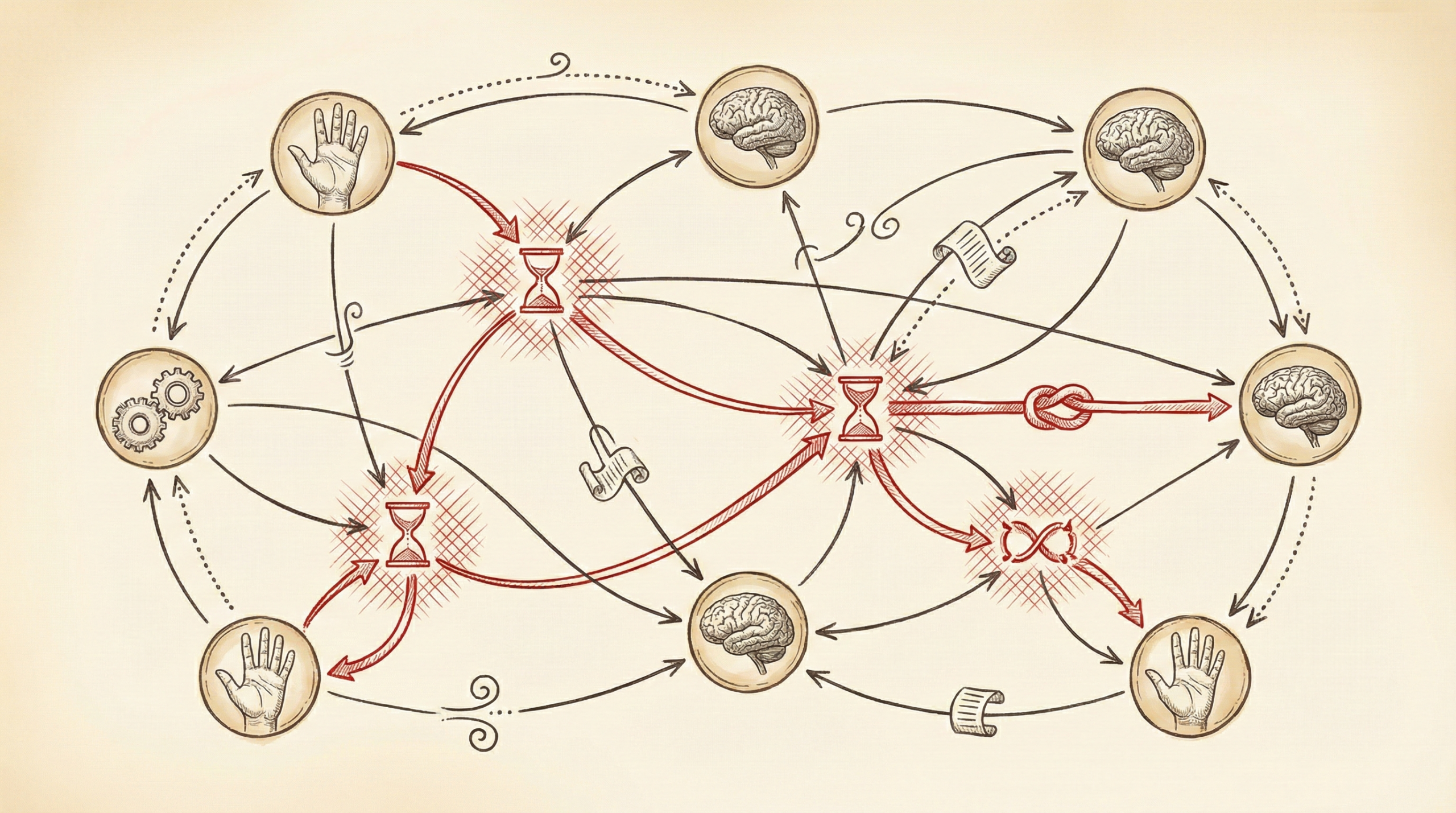
The mechanism is fascinating. When work hits a bottleneck, it doesn’t just slow down—it creates a cascade of secondary delays. Other team members either wait (idle time) or context-switch to other tasks (cognitive load). Both responses compound the original delay.
GitLab discovered this when they studied the “AI Paradox.” AI tools promise to speed up coding, but they’re creating new bottlenecks faster than they solve old ones. Teams report that AI accelerates individual coding but amplifies collaboration friction [2]. The result? Despite having superhuman coding assistants, teams are struggling with integration, compliance, and tool management bottlenecks they never had before.
“Focus on what you can control, not what happens to you. The bottleneck is not the problem—your response to it is.” – Marcus Aurelius (adapted for modern teams)
Why Eliminating Team Bottlenecks Is Your Competitive Advantage
While your competitors are hiring more people and buying more tools to solve speed problems, teams that eliminate bottlenecks are playing a different game entirely.
One organization in the i4cp study achieved $500 million in financial gains over two years [1] by systematically optimizing cross-functional connections across 89 countries. They didn’t hire thousands of new employees or implement revolutionary technology. They identified where collaboration was constrained and surgically removed those constraints.
The multiplier effect is real. When you eliminate your biggest bottleneck, you don’t just get faster—you unlock capacity that was always there. Teams that were “maxed out” suddenly have bandwidth for innovation projects. Decision cycles that took weeks compress into days. Information that was trapped in silos becomes accessible organization-wide.
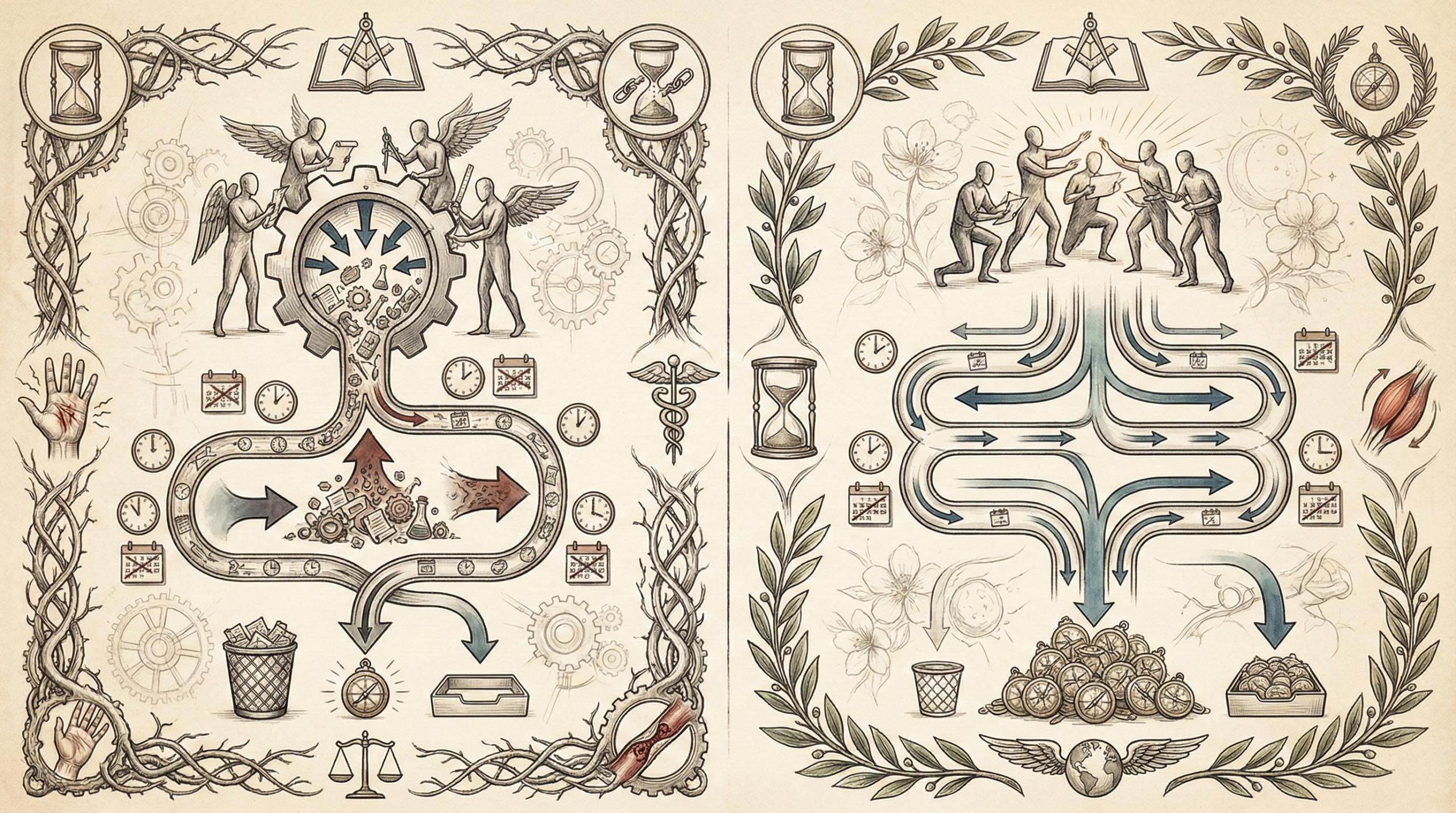
But here’s what most leaders miss: bottleneck elimination isn’t just about speed. It’s about engagement. Gallup’s research shows that only 21% of global workers are engaged [6], and much of that disengagement stems from the frustration of trying to do good work in broken systems. When you remove the friction that makes work unnecessarily hard, people naturally become more invested in outcomes.
Step-by-Step Guide: The STOIC Method for Bottleneck Elimination
After helping dozens of teams identify and eliminate their constraining factors, I developed a systematic approach. I call it the STOIC method—partly because it’s an acronym that works, but mostly because Stoic philosophy teaches us to focus on what we can control rather than what we can’t.
S – Survey Your Team’s Flow Patterns
Start by mapping where work actually flows, not where your org chart says it should flow.
The “Follow the Work” Exercise: Pick one common deliverable (like a feature request or customer support ticket) and trace its complete journey from initiation to completion. Document every handoff, every approval, every “waiting for” moment. Time each step.
I did this with a client’s content marketing team. On paper, blog posts took “about a week” from concept to publication. Reality? The average post spent 4.2 days waiting in various queues and only 2.8 days being actively worked on. The bottleneck wasn’t writing speed—it was approval workflow.
Questions to ask your team:
– Where does work sit the longest without being touched?
– What decisions consistently take longer than they should?
– Which handoffs require the most back-and-forth communication?
T – Track Communication Breakdowns
Communication breakdowns are bottlenecks disguised as people problems.
The Tool Audit: List every platform, app, and system your team uses for work. I’ve seen teams using email, Slack, Microsoft Teams, Zoom, Asana, Jira, Confluence, GitHub, and Google Drive simultaneously. Information gets trapped in each tool, creating artificial scarcity.
The Meeting Analysis: For one week, have every team member log meeting time with a simple question: “Could this have been an email or async decision?” You’ll be surprised how many meetings exist to solve problems created by poor information architecture.
O – Optimize Decision-Making Authority
Leadership bottlenecks are the most expensive because they cascade down to everything else.
Create RACI matrices for your most common decisions. Who is Responsible for execution? Who is Accountable for outcomes? Who needs to be Consulted? Who just needs to be Informed? Most teams have too many people in the “Consulted” category and unclear “Accountable” ownership.
I worked with a product team where every feature decision required input from seven stakeholders across four departments. The product manager spent more time scheduling decision meetings than making decisions. We redesigned their authority structure so that the PM could make features decisions autonomously within defined parameters, with other stakeholders moving from “Consulted” to “Informed.”
Result: Feature delivery time dropped from 6.2 weeks average to 2.1 weeks.
I – Invest in Skill Gap Closure
Sometimes your bottleneck is sitting right next to the solution, but you don’t know it.
Skills Inventory: Create a simple spreadsheet where team members list not just their job-title skills, but their hidden capabilities. The accountant who built databases in college. The designer who can code. The support agent who speaks three languages.
Cross-Training Strategy: Identify single points of failure—tasks that only one person knows how to do. These are human bottlenecks waiting to happen when that person goes on vacation, gets sick, or changes jobs.
C – Create Continuous Flow Monitoring
Bottlenecks are dynamic. Eliminate one, and another appears. Build systems that help you spot constraints before they become crises.
Weekly Bottleneck Check-ins: In your team meetings, add one simple question: “What’s currently slowing us down the most?” Track patterns over time.
Early Warning Metrics: Monitor leading indicators like cycle time (how long work takes from start to finish) and queue depth (how much work is waiting to be started). When these metrics spike, you’ve got bottlenecks forming.
Mistakes I Made: 5 Bottleneck Blindspots That Cost Me Months
Mistake #1: Assuming Tools Would Solve Collaboration Problems
Early in my consulting career, I convinced a client that their bottleneck was lack of project visibility. “You need better project management software,” I confidently declared. We implemented a sophisticated system with dashboards, automation, and real-time reporting.
The bottleneck got worse. Why? The problem wasn’t visibility—it was that three different departments had conflicting definitions of “project completion.” The new tool just made the confusion more visible and created additional overhead.
Lesson learned: Tools amplify your current processes. If your processes are broken, better tools make things worse, not better.
Mistake #2: Focusing on Individual Performance Instead of System Constraints
I spent three months coaching a “slow” developer, convinced that his coding speed was the team’s bottleneck. His manager was frustrated that features took too long to ship, and this developer was clearly the constraint.
Except he wasn’t. When I finally mapped their actual workflow, I discovered that completed features sat in a deployment queue for an average of 8.3 days because only one DevOps engineer could approve production releases. The developer was working at normal speed—the system was creating artificial delays downstream.
Lesson learned: Individual performance problems are usually system design problems in disguise.
Mistake #3: Adding More Meetings to Solve Communication Issues
“We need better communication” is the battle cry of teams drowning in bottlenecks. My reflexive solution was always the same: more meetings. Daily standups, weekly sync meetings, monthly all-hands, quarterly planning sessions.
Each new meeting created new coordination overhead. People spent more time talking about work than doing work. The communication bottleneck got worse because everyone was meeting-fatigued and information-overloaded.
Lesson learned: Communication problems are usually information architecture problems. Fix the systems, not the meeting schedule.
Mistake #4: Ignoring the Human Side of Bottlenecks
I once identified a perfect bottleneck elimination strategy for a client’s customer service team. On paper, it would reduce ticket response time by 67% and eliminate three handoff points. Foolproof plan.
The team hated it. The changes eliminated parts of their job they found meaningful and added tasks they found tedious. Within two months, they had unconsciously reverted to the old process with creative workarounds.
Lesson learned: Sustainable bottleneck elimination requires buy-in from the people doing the work. Involve them in designing solutions, not just implementing them.
Mistake #5: Trying to Fix Everything at Once
My biggest mistake was thinking that comprehensive solutions were better than targeted ones. I would present clients with detailed transformation plans addressing every bottleneck I could identify. Change the org structure, implement new tools, redesign workflows, retrain staff—everything at once.
These grand plans created change bottlenecks that were worse than the original problems. Teams got overwhelmed, adoption failed, and we ended up with hybrid systems that combined the worst of old and new approaches.
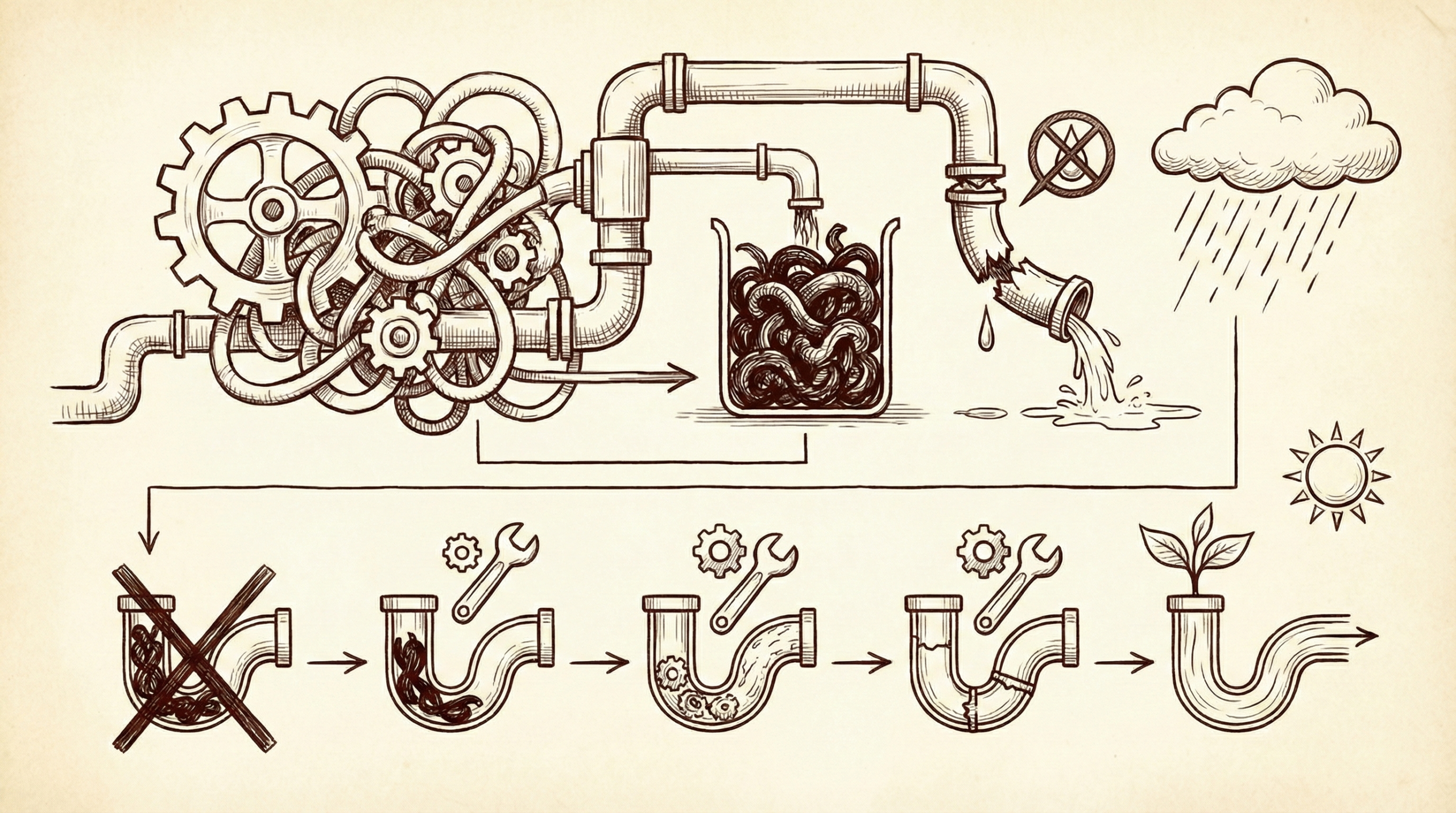
Lesson learned: Fix your biggest bottleneck first. Then let the system stabilize before identifying and fixing the next constraint. Theory of Constraints works in business just like it works in manufacturing.
Advanced Variations: Precision Bottleneck Surgery for High-Performing Teams
Once you’ve mastered basic bottleneck identification, advanced teams can use more sophisticated techniques.
Network Analysis for Collaboration Optimization
Map your team’s communication patterns using network analysis tools. Who talks to whom? Where are information bridges? Where are structural holes that create delays?
I worked with a 200-person engineering organization that used email metadata (anonymized) to visualize their actual collaboration network. They discovered that 73% of cross-team communication flowed through just four people—human bottlenecks who didn’t even realize they were constraining information flow.
By redistributing some of these connections and creating direct pathways between teams, they eliminated 2.3 days average from feature delivery cycles without changing any individual’s workload.
AI-Powered Bottleneck Detection
Modern teams can use AI to automatically identify workflow constraints by analyzing task completion patterns, communication frequency, and delivery cycles.
Platform Engineering Approach: GitLab’s research shows that 85% of teams view platform engineering as essential [2] for resolving AI-related delays. Instead of each team managing their own tool integration, platform teams create standardized workflows that eliminate coordination bottlenecks.
Predictive Bottleneck Prevention
Advanced teams don’t just fix bottlenecks—they predict and prevent them.
Capacity Planning Models: Track team velocity over time and identify patterns that precede bottleneck formation. For example, teams often hit bottlenecks 2-3 sprints after taking on high-complexity projects, even if current capacity looks fine.
Scenario Modeling: Before making organizational changes, model how they will affect information flow and decision cycles. Where will new constraints appear? How will eliminating one bottleneck shift load to other parts of the system?
Real Examples: Companies That Solved Their “Always Behind” Problem
Case Study 1: Global Tech Company’s $500M Transformation
The Challenge: A multinational technology company with operations across 89 countries was struggling with cross-functional collaboration. Product launches consistently missed deadlines, regional teams worked in silos, and information took weeks to flow between departments.
The Investigation: Rather than assuming they needed more coordination, they mapped their actual collaboration networks. The analysis revealed something surprising: they didn’t need more connections between teams—they needed better connections. Most cross-functional communication was happening through informal channels that created single points of failure.
The Solution: They implemented “precision collaboration”—strategically designed high-quality connections between specific roles in different functions. Instead of having everyone talk to everyone, they created clear information pathways with designated liaisons who had authority to make decisions.
The Results: $500 million in financial gains over two years [1]. Product launch cycles shortened by 43%. Employee engagement increased because people spent less time in coordination meetings and more time on their core expertise.
Key Lesson: More collaboration isn’t always better collaboration. Quality of connections matters more than quantity.
Case Study 2: DevSecOps Team’s 7-Hour Weekly Recovery
The Challenge: A 40-person DevSecOps team was drowning in tool complexity. They had implemented AI coding assistants to speed development, but somehow features were taking longer to ship than before. Developers were frustrated, and management was confused about why productivity investments weren’t paying off.
The Investigation: GitLab’s research revealed this as a common “AI Paradox”—AI accelerates individual coding but creates new bottlenecks in collaboration, compliance, and integration [2]. The team was using 12 different development tools, and AI-generated code often failed security and compliance checks, creating rework loops.
The Solution: Platform engineering approach with tool consolidation. They created standardized workflows that embedded compliance checking into the AI-assisted coding process, reduced their toolchain from 12 to 5 integrated platforms, and established clear handoff protocols between AI-assisted development and human review.
The Results: Eliminated 7 hours of weekly inefficiencies per team member [2]. Feature delivery speed increased 34% despite spending less time in development. Code quality improved because compliance was automated rather than manually checked afterward.
Key Lesson: Modern tools require modern collaboration strategies. Adding AI without redesigning workflows just automates your bottlenecks.
Case Study 3: Manufacturing Team’s 54% Profitability Jump
The Challenge: A manufacturing team consistently ranked in the bottom quartile for productivity and profitability. Management had tried individual performance improvement plans, new equipment, and process documentation. Nothing moved the needle significantly.
The Investigation: Network analysis revealed that decision-making authority was heavily concentrated in middle management, creating approval bottlenecks for routine operational decisions. Floor workers had valuable process improvement ideas but no mechanism to implement them quickly.
The Solution: Redesigned decision authority using the STOIC method. Frontline workers received authority to make certain process improvements autonomously. Middle managers shifted from approval-givers to coaches and resource providers. Cross-functional connections were strengthened between production, quality, and maintenance teams.
The Results: Projected 54% profitability improvement [1] as the team moved from bottom to top quartile performance. Employee engagement scores increased dramatically because workers could solve problems they identified instead of waiting for permission.
Key Lesson: Leadership bottlenecks often have the highest ROI when fixed, but they require cultural change, not just process change.
Frequently Asked Questions
How do I identify bottlenecks if my team seems to be working hard?
High activity doesn’t equal high productivity—this is the most common bottleneck blindspot. Teams can be incredibly busy while accomplishing very little due to system constraints. Start with the “waiting game” analysis: track where completed work sits idle waiting for the next step. Ask your team these diagnostic questions: “What are you waiting for to move this forward?” and “How much time do you spend coordinating versus executing?” Often, the hardest-working teams have the most bottlenecks because they’re compensating for system dysfunction with individual effort.
What’s the difference between individual and system bottlenecks?
Individual bottlenecks are person-based constraints—when one team member’s capacity, skills, or availability limits the entire team’s throughput. System bottlenecks are process and structure constraints that would slow down any person in that position. Here’s the key insight: system fixes usually have bigger impact because they eliminate the constraint permanently rather than just shifting it. If your “slow” developer left tomorrow and the replacement had the same problems, you’re dealing with a system bottleneck disguised as a people problem.
How long does it take to see results from bottleneck elimination?
Timeline varies by bottleneck type, but you should see some improvement quickly if you’re targeting the right constraint. Simple process fixes (like eliminating unnecessary approval steps) can show results in 2-4 weeks. Communication improvements typically take 2-3 months as new information flows become habitual. Major cultural and system changes require 6-12 months for full impact. The key is starting with your biggest bottleneck first—teams that fix their primary constraint see results 3x faster than those who try to improve everything simultaneously.
Can AI help identify bottlenecks automatically?
Yes, but with important limitations. AI excels at analyzing workflow data, task completion patterns, and communication frequency to identify statistical anomalies that indicate bottlenecks. Tools can automatically flag when cycle times spike, queue depths increase, or handoff points create delays. However, AI currently struggles with context—understanding why bottlenecks exist and what human factors contribute to them. The most effective approach combines AI-powered data analysis with human insight about team dynamics, organizational politics, and cultural factors that data alone can’t capture.
Why do some teams resist bottleneck elimination changes?
Resistance usually signals that you’re solving the wrong problem or not involving the right people in solution design. Teams often resist changes that eliminate meaningful parts of their work, add tasks they find tedious, or feel imposed rather than collaborative. The most sustainable bottleneck elimination involves the people doing the work in identifying constraints and designing solutions. Sometimes what looks like a bottleneck from the outside serves an important purpose that isn’t visible to management—like informal quality checks or relationship maintenance that formal processes don’t account for.
Your Next Step: The 15-Minute Bottleneck Audit
Here’s what I want you to do before you close this browser tab: spend 15 minutes conducting the “Three Question Bottleneck Audit” with your team.
Question 1: Where does work wait the longest in our process?
Question 2: What decisions consistently take longer than they should?
Question 3: Which team member, tool, or approval step is most often the constraint?
Don’t overthink this. Don’t schedule a meeting. Just ask these questions and write down the first answers that come to mind. In 15 minutes, you’ll have identified your biggest bottleneck.
Then come back and implement the STOIC method to eliminate it systematically. Remember the Stoic principle that Marcus Aurelius would appreciate: focus on what you can control—your response to constraints—rather than lamenting that constraints exist.
The research is clear: teams that fix their biggest bottleneck first see results 3x faster [1] than those who try to fix everything at once. Your team doesn’t need to be behind anymore. They just need you to identify what’s actually slowing them down.
References
[1] (). Bottleneck Analysis and Productivity Improvement in Manufacturing (inferred from study context). Amrita School of Engineering Research. https://bfi.uchicago.edu/insight/research-summary/bottlenecks-sectoral-imbalances-and-the-us-productivity-slowdown/ [^]
[2] (2019). Bottleneck Mitigation in Manufacturing Processes. Unknown Journal. https://www.researchpublish.com/papers/operational-bottlenecks-and-workforce-efficiency-a-quantitative-evaluation-using-the-theory-of-constraints-in-healthcare [^]
[3] (). Dynamic Data-Driven Approaches for Bottleneck Detection. Unknown Journal. https://www.nber.org/papers/w31427 [^]
[6] (). Using AI to Uncover Process Bottlenecks Across Departments. TechClass Study. https://www.techclass.com/resources/learning-and-development-articles/using-ai-to-uncover-process-bottlenecks-across-departments [^]